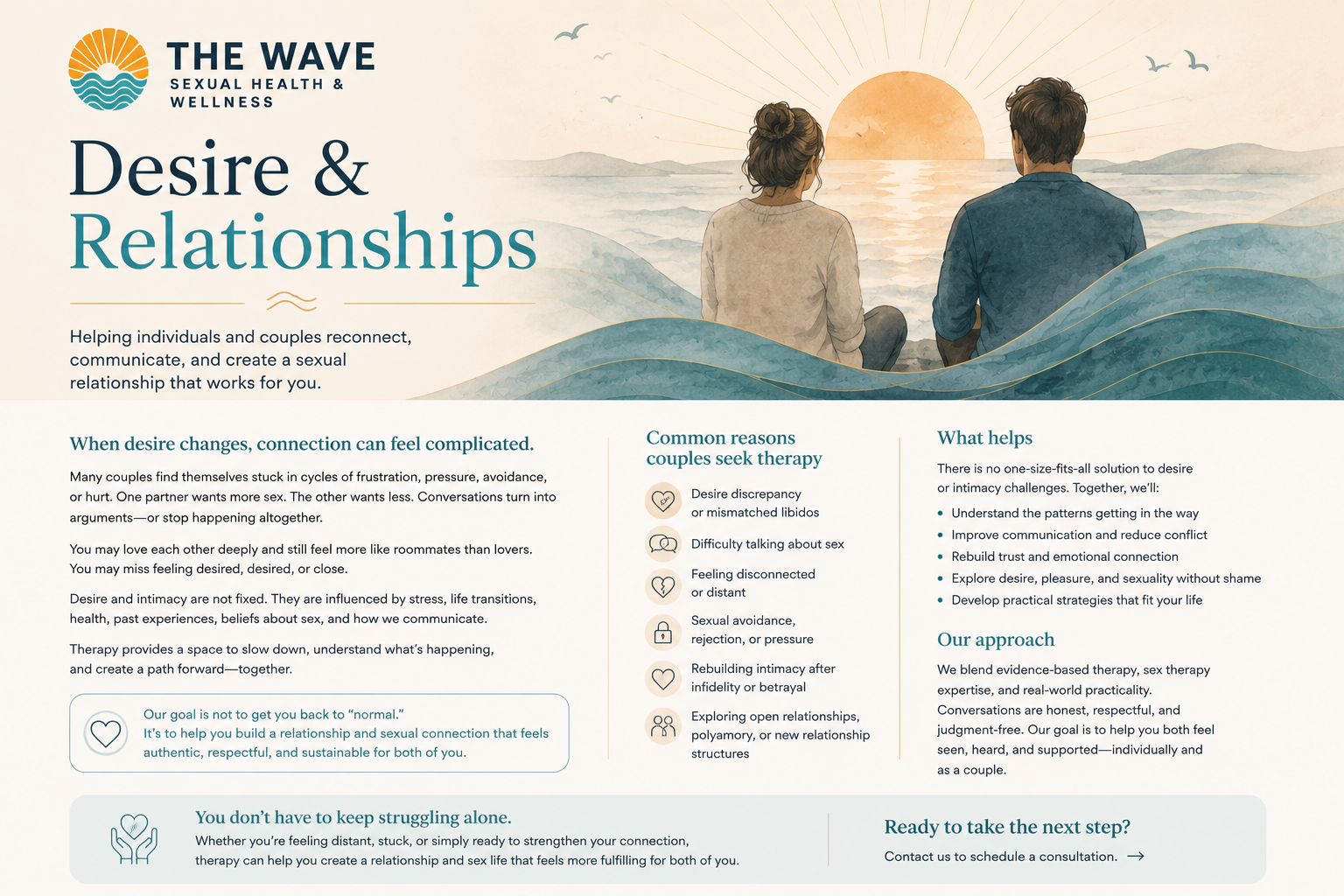
Desire & Relationships
Sometimes the problem isn't that you don't love each other.
Sometimes the problem is that your relationship has become caught in a cycle that neither of you knows how to stop.
One partner wants more sex. The other wants less.
One partner feels rejected. The other feels pressured.
Conversations about intimacy become arguments—or stop happening altogether.
Over time, it's easy to begin feeling more like roommates than romantic partners.
The good news is that this pattern is incredibly common, and it can change.
When desire changes, relationships change.
Sexual desire isn't fixed. It changes throughout our lives in response to stress, health, hormones, parenthood, aging, medication, mental health, relationship dynamics, and countless other experiences.
The problem isn't that desire changes.
The problem is that most couples were never taught how to navigate those changes together.
Instead, couples often become trapped in patterns of blame, withdrawal, avoidance, resentment, or obligation that slowly erode emotional and sexual connection.
Therapy provides a space to understand those patterns and begin creating new ones.
Common Reasons Couples Seek Therapy
Many couples come to therapy because they are experiencing:
Desire discrepancy (different levels of sexual desire)
Sexual disconnection
Difficulty talking about sex
Rebuilding intimacy after infidelity
Changes in sexuality after children
Performance anxiety affecting the relationship
Low or changing desire
Communication difficulties
Opening a relationship or exploring consensual non-monogamy
Sexual dissatisfaction despite loving one another
You don't have to wait until your relationship is in crisis to benefit from therapy.
Desire Discrepancy Is One of the Most Common Relationship Challenges
Almost every long-term couple experiences differences in desire at some point.
Unfortunately, many couples begin believing that one person is "the problem."
The higher-desire partner often feels unwanted, rejected, or lonely.
The lower-desire partner often feels pressured, criticized, or like they can never "get it right."
Neither experience is wrong.
My goal isn't to decide whose desire is normal.
My goal is to help you understand what is happening beneath the pattern so the two of you can begin working together instead of against one another.
Sex Therapy Isn't About Having More Sex
One of the biggest misconceptions about sex therapy is that the goal is simply to increase the frequency of sex.
It isn't.
The goal is to help you create a sexual relationship that feels authentic, mutually satisfying, emotionally connected, and consistent with your shared values.
Sometimes that means improving communication.
Sometimes it means rebuilding trust.
Sometimes it means healing from years of hurt or misunderstanding.
Sometimes it means redefining what intimacy looks like for your relationship.
There is no one "correct" sex life.
There is only the one that works for the two of you.
My Approach
I believe good couples therapy balances compassion with curiosity.
Rather than deciding who is right, we'll work together to understand the biological, psychological, relational, and cultural influences affecting your relationship.
We'll identify the cycles that keep you stuck, improve communication around difficult topics, and develop practical strategies that strengthen both your emotional and sexual connection.
My work is evidence-informed, direct, and sex-positive.
I also provide LGBTQIA+ affirming care and work with couples in diverse relationship structures, including consensual non-monogamy and polyamory.
Common Myths About Desire
Myth: If we truly loved each other, we'd naturally want sex the same amount.
Reality: Differences in desire are one of the most common experiences in long-term relationships. Love and desire are related—but they are not the same thing.
Myth: The partner with less desire is the problem.
Reality: Desire discrepancy is a relationship dynamic, not an individual diagnosis. Lasting change comes from understanding the pattern, not assigning blame.
Myth: Good sex should happen spontaneously.
Reality: Long-term sexual relationships often require intention, communication, flexibility, and adaptation as life changes.
Myth: If we're arguing about sex, our relationship must be failing.
Reality: Many healthy couples struggle with intimacy at different stages of life. Learning how to navigate those conversations often strengthens the relationship.
Frequently Asked Questions
Do both partners need to attend therapy?
Not always. Many couples begin therapy together, while others start individually. We'll determine the approach that best supports your goals.
What if we're embarrassed to talk about sex?
That's completely normal. Most couples aren't used to having open conversations about sex. My role is to create an environment where those conversations become easier—not more uncomfortable.
Can therapy really help desire discrepancy?
Yes. While therapy doesn't "fix" desire by making both partners identical, it can help couples understand the factors influencing desire, improve communication, reduce conflict, and rebuild intimacy.
Do you work with LGBTQIA+ couples?
Absolutely. My practice is LGBTQIA+ affirming and welcomes couples of all sexual orientations, gender identities, and relationship structures.
Reconnect With Each Other
Many couples spend years trying to solve sexual concerns on their own.
You don't have to.
Whether you're feeling disconnected, stuck, frustrated, or simply want to strengthen your relationship, therapy can help you better understand one another and build a sexual relationship that works for both of you.
You don't need a perfect relationship to begin.
You just need a willingness to have the conversation.